


 Refine Search & Sort
How EV Charging Works in the UK
Electric vehicle charging in the UK is straightforward once you understand the three main options: home charging, public charging points and rapid charging. Most UK drivers rely on home charging for daily use, while public and rapid chargers are useful for topping up on the move or during longer journeys.
EV Charging Basics Explained. How Do Electric Cars Charge?
An EV stores electricity in a battery, and charging simply means transferring power from a socket or charger into that battery. The charging speed depends on the charger type, the car’s onboard charging capability, battery size and, in some cases, battery temperature.
Charging speed depends on several factors:
- Charger type and power output
- The vehicle’s onboard charging capacity
- Battery size
- Battery temperature
In the UK, chargers are usually described by power output in kilowatts, or kW. In general, the higher the kW rating, the faster the charge, although your car may not always accept the charger’s full maximum rate.
Electric Cars Charging Speed Comparison

EV Home Charging. The Most Convenient and Cost-Effective Option
Home EV charging is the most convenient and often the cheapest way to run an electric car in the UK.
A typical setup includes a dedicated wallbox charger installed at your property, usually delivering between 3.5 kW and 7.4 kW. Some homes can support higher speeds depending on the electrical supply.
Home charging is ideal for overnight use. Most drivers plug in at the end of the day and wake up with a fully charged battery, ready for everyday driving.
Home chargers work best with off-street parking such as a driveway or garage. While solutions exist for homes without a driveway, installation can be more complex.
Public EV Charging Points UK: Where and How to Charge on the Go?
Public chargers are found in places such as supermarkets, car parks, retail parks, restaurants and service stations. They are useful when you are away from home, cannot charge on your driveway, or want to add range during the day.
Public charging is often started using an app, an RFID charge card, contactless payment or a card reader, depending on the operator. UK rules mean that newer chargers are increasingly required to offer contactless payment and clear pricing information.
Most public chargers can be accessed using:
- Mobile apps
- RFID charge cards
- Contactless payment
There are different public charger speeds, and they suit different use cases. A destination charger at a supermarket is fine for a longer stop, while a charger at a motorway service area is better for a quick top-up.
Rapid EV Charging UK: Fast Charging for Long Journeys
Rapid EV charging is designed for fast top-ups, especially on long trips. These chargers are typically found at motorway services, large retail parks and dedicated charging hubs, and they can add a significant amount of range in a short time.
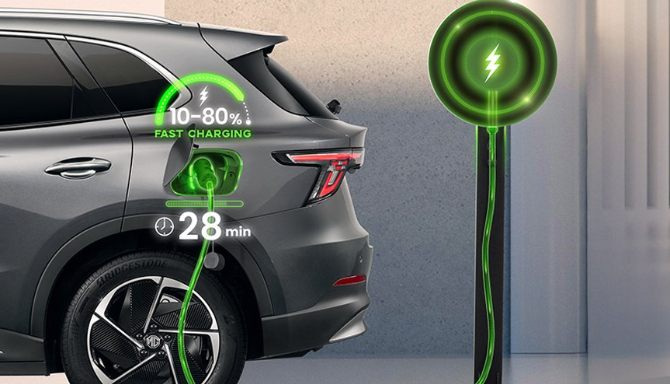
A rapid charger is usually much faster than a home or standard public charger, but the exact speed depends on your car and the charger itself. Some rapid chargers can take a battery to around 80% in as little as 15 to 60 minutes, though the charge often slows down near the top to protect the battery.
Ultra-rapid chargers are the fastest public option and are most useful for drivers who do long distances regularly. Even so, your vehicle must be capable of accepting that charging rate for you to benefit fully.
What Affects EV Charging Speed? Key Factors Explained
Several factors influence how quickly your electric vehicle charges:
- Charger power output
- Vehicle charging capability
- Battery size
- Battery temperature
- Current battery level
Charging is often fastest when the battery is low to medium full. As the battery fills up, the speed usually drops, which is why many drivers aim for around 80% on rapid chargers rather than waiting for 100%.
Choosing the Best EV Charging Option for Your Lifestyle
For most people, home charging is the simplest and cheapest way to keep an EV ready for daily use. Public charging is useful for flexibility, while rapid charging is the best choice when time matters or when you are travelling far from home.
A practical routine for many drivers is to charge at home overnight, use public chargers during shopping or work, and rely on rapid charging only for longer journeys.
EV Charging FAQs
Can I charge an EV from a standard household socket?
How long does EV charging take in the UK?
Are all public EV chargers the same?
Why does EV charging slow down after 80%?
Do I need an app to use public EV chargers?
Is rapid charging bad for an EV battery?
Can I use any charger with any electric car?
What is the cheapest way to charge an electric car?
Ready to Switch to an Electric Car?
Switching to electric driving is more straightforward than many people expect. With clear information and expert guidance, you can make the move with confidence.
If you have a question that is not covered in our EV Knowledge Hub, our team is here to help.
Book your free EV consultation and get personalised advice from our electric car experts.
We will help you choose the right vehicle, explain home charging options and guide you through running costs, servicing and battery technology, giving you everything you need to switch to electric with confidence.

Fill in your details below and a specialist will be in touch.
By Providing your details you consent to us being able to contact you using the methods given above.


Fill in your details below and a member of our team will be in touch

By providing your details you consent to us being able to contact you using the methods given above. Read more.
Please provide your details below and a member of our team will be in touch
Your current car
By providing your details you consent to us being able to contact you using the methods given above. Read more.
Fill in your details below and a member of our team will be in touch

Great that's all sorted!
Thank you for choosing Brayleys for your service
A member of the team will be in touch shortly to book you in for your appointment, we look forward to welcoming you to the dealership.